


KASON-TR200B Building Block (vacuum) Parallel Twin Screw Extrusion Platform Mixer Torque Rheometer
- Electric motor rotating speed
2000r/min
- Reduction ratio
10:1
- Melt pressure measurement range
0.1~100Mpa
- Range of rotating speed
0.1~200 rpm
Torque rheometer is an ideal equipment to study the flow and deformation, plasticization, thermal shear stability, dynamic rheological properties and plasticization behavior of polymer materials and show the results in the form of torque-time and torque-temperature
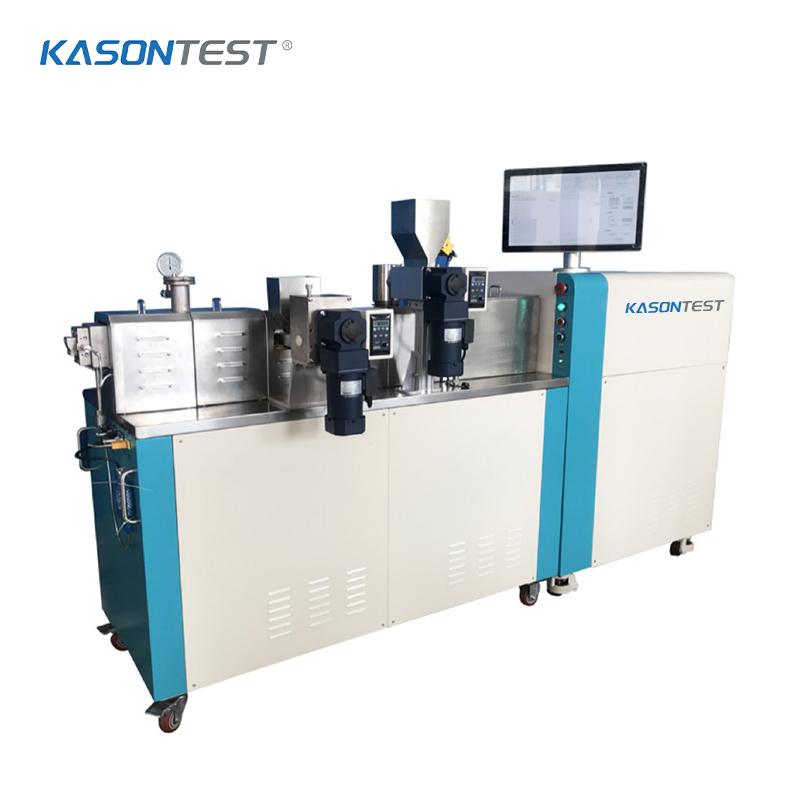
KASON-TR200B Building Block (vacuum) Parallel Twin Screw Extrusion Platform Mixer Torque Rheometer
KASON-TR200B Building Block (vacuum) Parallel Twin Screw Extrusion Platform Mixer Torque Rheometer
Torque rheometer is an ideal equipment to study the flow and deformation, plasticization, thermal shear stability, dynamic rheological properties and plasticization behavior of polymer materials and show the results in the form of torque-time and torque-temperature
Request a QuoteProduct Details
Ⅰ、Scope of application
Torque rheometer is an ideal equipment to study the flow and deformation, plasticization, thermal shear stability, dynamic rheological properties and plasticization behavior of polymer materials and show the results in the form of torque-time and torque-temperature,and the mixing of multi-component materials, the cross-linking curing of thermosetting resins, the vulcanization of elastomers, the dynamic stability of materials and the influence of screw rotating speed on the processing performance of the system, etc. It can be widely used in scientific research and production, laboratory simulation in the mixing, extrusion process, a series of data to guide the reality of formula research and production, can be similar to the actual processing, continuous, accurate, reliable to determine the rheological properties of the material.
Ⅱ、Product function
It has modular design and ready-to-use function: the host is the control center, which has the function of driving and controlling the measuring unit; the controlled auxiliary units (such as mixing units and extrusion units) are intelligent measuring units for specific applications, which can transmit the measurement data to the host through the bus system. It can be equipped with various auxiliary units to complete laboratory simulation experiments for different purposes.
Ⅲ、Instruction of Building Block Parallel Twin Screw Extruder
Building Block Twin Screw:It is composed of screw elements with different numbers and functions, which are installed on a keyed or hexagonal mandrel according to certain requirements and sequence. According to the processed materials and different process requirements, different quantities and different types of screw components and their best combinations can be selected for extrusion processing. In this way, limited screw elements can be used to meet different requirements through different combinations, thus solving the contradiction between the versatility of processing needs and the specificity of the machine.
(1) Screw combination
The screw of twin-screw extruder generally adopts building blocks or combined types in mechanical structure.This makes the screw configuration, barrel structure, length-diameter ratio, the position and number of the feeding port and vacuum exhaust port of the twin-screw extruder need to be adjusted according to the changes in the material system and process requirements, in order to achieve the unity of universality and specificity.
Twin-screw extrusion process: feeding, solid conveying, melting, mixing, exhaust, conveying and other functional segments。
Different functional sections require different local screw configurations to adapt to them and achieve different functions. The design of screw combination configuration is an important and difficult issue, because it is related to many factors, such as the properties of the processed materials and the formulation design, the operating conditions and the performance of the screw elements. This combination is also a special technology and know-how. There is no formula to follow. Generally, it is necessary to understand the performance of various screw elements and material properties, and design through a combination of experience, theory and experiment.
(2)Screw elements
If the material conveying process in a twin-screw extruder is divided into solid conveying zone, melting zone and melt conveying zone like the conveying process in a single-screw extruder, then corresponding to the phase change of the material during the extrusion process, a whole screw can be decomposed into different functional segments, and different functional segments use the same geometric structure to complete their functions. The screw segments that can achieve different functions are called screw elements. According to the different functions achieved, screw elements can be divided into conveying elements (composed of forward thread elements, with different numbers of screw heads and leads), pressure building elements (mainly reverse thread elements), shearing elements (kneading disks and their combinations), mixing elements (mainly toothed disk elements), etc.
Product parameters
4.1、Measurement and control host
|
Electric motor power(Panasonic electric motor、controller) |
5.0kW |
Torque measurement accuracy |
±0.3%F.S. |
|
Electric motor rotating speed |
2000r/min |
Melt pressure measurement range |
0.1~100Mpa(Can be customized according to user requirements) |
|
Reduction ratio |
10:1 |
Pressure measurement accuracy |
+0.3 %F.S. |
|
Range of rotating speed |
0.1~200 rpm |
Temperature control range(Five-way temperature control) |
Room temperature~350℃ |
|
Speed control accuracy |
±0.1%F.S. |
Temperature control accuracy |
+0.5℃ |
|
Torque measurement range |
0 ~ 200Nm (Rated torque 300Nm) |
Graphical display |
Rotating speed, torque, temperature, pressure |
|
Voltage |
AC380V 7.5kw |
|
|
|
1060*650*1540mm |
Host weight |
225kg |
|
|
Packed dimension(L*W*H) |
1100*790*1610mm |
Packed weight |
255kg |
Download
| Name | Download |
|---|---|
| KASON-TR200B Building Block (vacuum) Parallel Twin Screw Extrusion Platform Mixer Torque Rheometer.pdf |
Applicable industries

Related Products

-
Telephone:+86 15910081986
Address:NO.4715, JINGSHI WEST ROAD, HUAIYIN DISTRICT, JINAN, SHANDONG, CHINA
Mailbox:admin@jnkason.com
-
Testing machine equipment metallographic analysis hardness tester series
Non-destructive testing equipment Material analysis instruments
©2026 Jinan Kason Testing Equipment Co., Ltd.